

This is the transcript of a speech I gave recently to a group of senior Australian leaders
First of all, thank you for inviting me. It’s an honour to be able to speak with such an illustrious group about the role of Australia in this new world of artificial intelligence.
Today, I want to talk about where Australia stands in the world of AI – and, more importantly, where it should.
But first, a story.
Twenty-five years ago, I completed a PhD in artificial intelligence at the University of Edinburgh. Through pure serendipity, I landed a job at NASA, in the heart of Silicon Valley.
NASA was transforming from a hardware to a software-led organisation. After crashing Mars Polar Lander and Mars Climate Orbiter into the red planet’s surface – both the result of software problems – NASA realised it needed a crack team of software specialists. I was an early member of that team.

My job was simple: build an AI that could write code for NASA space missions. It didn’t work. Not really. I could get a rule-based system to glue software components together for specific applications, but an AI that could write any code, any time, for any application? That seemed impossible.
In short, I failed. I failed to get AI to write code by itself. And I never managed to get my work into space.
I thought we would never reach a point where AI could write software by itself. And yet, here we are. In the last few weeks, I’ve heard countless stories of software developers excitedly claiming that they don’t need to code any more. Or that 100% of their software is now written by AI. We even hear that AI is creating AI: Boris Cherny, who leads Anthropic’s AI coding work, says their latest desktop product was “pretty much all” built by AI.
When ChatGPT launched in November 2022, it became the fastest-adopted technology in history. Three years later, you’d be hard pressed to find anyone who isn’t conversing with AI.
But the real revolution isn’t chatbots. It’s AI that can write software. Software runs our lives. In 2011, Marc Andreessen famously said that software is eating the world – meaning that software wasn’t just improving existing businesses, it was replacing them.
Fast forward 15 years and it’s not that software is eating the world; software is itself being eaten – by AI. A fortnight ago, the launch of a new AI legal tool led investors to flee from software stocks – at the prospect of AI replacing specialist software the way Netflix replaced Blockbuster. The risk to Australian software companies is clear: Wisetech shares are down 60% in the last 6 months, Atlassian is down 45%, Xero 55%. AI isn’t just eating the software industry, it’s gorging on it.
Now, let me be clear.
There’s a lot of hype when it comes to AI. Those share price falls aren’t only down to AI. And I don’t necessarily believe that the bottom is about to fall out of the software industry. I’m the last person to hype up AI – I’ve spent much of my career cautioning against unbridled enthusiasm. But, as entrepreneur Matt Shumer recently wrote, something big is happening. AI isn’t just chatbots any more. It isn’t just automating inefficient business processes. We’re conceivably close to a point where AI could be writing all the software on which a modern economy depends.
Australia cannot afford to sit this one out.
So, where does Australia stand in the world of AI?
There are positives and negatives. Let’s start with the good news.
We have fantastic AI research capability in Australia. According to one study, Australia ranks 4th in the world in terms of AI research outputs – that’s not per capita, that’s absolute numbers of research publications. We lag behind only the US, China and the UK.
Our problem though has never been research, but how we commercialise that research. But here too, things are beginning to improve. Funding for aussie tech startups rose by $1Bn last year, the best result since the 2022 global tech correction. Of these startups, AI startups are growing at twice the rate. And 60% of early-stage investments are in core AI startups. Just last week, Australia got its latest unicorn, valued at $1Bn – in what? AI, of course. Applied to the optimisation of energy infrastructure.
Some of our large corporates are at the forefront of AI – CBA, for example, ranks 4th in the world for AI maturity among banks. And we’ve had some notable successes in developing AI innovations. Leonardo, for example, was one of the first AI image generation tools globally, launched around the same time as ChatGPT, and later acquired by Canva for $320M. And Atlassian has quietly rolled out its own AI tool, Rovo, which, as I understand it from colleagues, is used by all Atlassian developers to build its software products.
Australia has also been among the leaders in the world when it comes to responsible and safe AI. My team at CSIRO developed one of the world’s first AI Ethics frameworks back in 2019. At CSIRO, I created and grew one of the world’s largest responsible AI teams. Australia now ranks in the top 10 in the Global Responsible AI Index.
Recently, Australia is emerging as a major investment hub for data centres – ranking 2nd globally in 2024.
These aren’t just numbers. I’ve seen what Australian AI can do when we back it.
My team at CSIRO developed an AI system that can accurately predict the path of bushfires in real-time so that scarce firefighting resources can be directed to where they are needed most. This system, Spark, has been rolled out by AFAC as part of the national bushfire capability.
Another of my teams developed AI that is helping protect the Great Barrier Reef against Crown of Thorns starfish. An AI-enabled underwater glider can identify these poisonous starfish much more efficiently than human divers.
And, although when I worked at NASA, I wasn’t able to get my own AI into space, I am happy to report that I finally achieved it – the CSIRO robotics team worked with NASA to create an AI astronauts’ assistant which is flying on the International Space Station as we speak!

But for all that promise, not everything is rosy.
Government investment in Australian AI is dwarfed by even similar sized countries. Depending on how you count, Australia has invested around half a billion dollars in AI; that compares to around five billion in Singapore.
So far, the vast majority of Australian AI has focused on adapting AI models developed elsewhere. Practically speaking, there are no Australian foundation models. Foundation models are the engines of AI – they are what power ChatGPT, Gemini, Deepseek and Claude. But foundation models are heavily dominated by the US and China, which between them build 80% of all models. Australia has 0%.
In some ways, Australians seem indifferent to AI. According to a survey conducted by KPMG and the Melbourne Business School, Australians are among the least trusting in AI – ranking 6 from bottom among 47 countries. Worse, Australians have low AI literacy rates, ranking the lowest globally in their interest in learning more about AI.
It sometimes feels that Australia is held back by a lack of ambition, a lack of drive, and a lack of interest in realising what AI could do for us.
We have the potential in Australia to be a thriving medium power in AI. My fear is that we don’t have the guts for it. And that we are content instead to be a nation of AI consumers not AI builders.
We need to invest in core AI technologies, not just apply AI to mining, agriculture and healthcare. We need to build our own sovereign AI – for independence, yes, but also to build new economies beyond digging things out of the ground.
This is not a popular argument. Things usually go like this: Australia is too small to compete with the big guys like OpenAI or Anthropic. It’s too expensive to build our own AI models. We should just stick with what we are good at.
But there are risks of doing nothing.
AI now touches every aspect of Australian life. Without sovereign AI, we are exposed to serious geopolitical risk. We’ve seen with COVID and with tariffs that the world order can shift overnight. And we’ve seen the rise of China. In January last year, a Chinese company released Deepseek – an AI model just as capable as the best in the world, at a fraction of the cost.
Chinese AI isn’t yet dominant in Australia, but it could be. Ten years ago, no Australians were buying Chinese cars. And yet, today, BYD is selling 10x more electric vehicles in Australia than Tesla. It’s not hard to imagine that in ten years, cheaper, ‘good enough’ Chinese AI will be as ubiquitous in Australia as Chinese EVs are today.
Beyond geopolitics, there is economic risk. AI is slowly but surely rewriting economic models. Take software. Engineers who use AI to write code pay by buying tokens from a model provider. And as most of those models come from the US and China, that money goes offshore. If AI coding develops as quickly as many think it will, we could soon be in a situation where Australian companies are developing products in Australia but paying other countries for the privilege. AI is already disrupting industries and creating new ones. Do we not want a share of what comes next?
One common argument against Australia developing its own AI is that it costs too much. Companies like OpenAI have spent billions. We don’t have that kind of cash to spend, right? But AI doesn’t have to cost billions. Deepseek proved that. And there are now two Australian startups attempting to develop AI models for tens of millions, not billions.
So what should be done?
The Australian Academy of Technological Sciences and Engineering has called for $5Bn of government investment to get Australia to the starting line.
But, in my view, they are making a fatal mistake: they are waiting for government to make the first move.
Having spent five years in government – and secured over $100M in investment for initiatives like our National AI Centre – I am not hopeful that government will invest those sums.
In December last year, the government released its long-awaited National AI Plan, but it has received mixed reviews. There is no significant new investment, and it risks becoming – like the National Robotics strategy before it – a piece of paper on a politician’s shelf.
One view of the national AI plan is that it’s not an AI plan at all, but a data centre plan. Australia is now genuinely positioning itself as an Asia Pacific hub for data centre development: we have plentiful land, stable politics, and an opportunity for sustainable data centres. The data centre focus makes sense. But it shouldn’t be the only thing we do.
I don’t think it’s government’s job to fix this. Though it could help by reducing the regulatory burden. By some projections, AI could add roughly $150 billion a year to Australia’s economy. Any guesses on the annual regulatory burden costs? About the same.
Our real problem isn’t money, it’s mindset. We don’t need any more plans; we need persistence to put them in place.
Smarter people than me have written about redesigning Australia’s innovation ecosystem. I have no illusions that I have the answers here, so I won’t attempt today to fully solve the problem.
But I will talk about FIVE things which I think could help.
First, we need to build our own foundational AI models. Not to compete with ChatGPT, Claude or Gemini, but to provide a home-grown alternative for those who want it. The aim isn’t to have the best model in the world but to have something we can build on. Otherwise, the rest of our AI economy is built on sand.
Second, home-grown foundation models are a start, but not the endgame. The economic opportunity doesn’t end with today’s AI. We may have lost the current race – the race to build large language models. But most AI experts believe that today’s AI isn’t the final word. To achieve true intelligence, we’ll need fundamentally new approaches. Even if we’ve lost the current race, Australia should be positioning itself for the race that is still to come.
Third, we should go all in on areas of competitive advantage. In my view, one of those is “AI for science” – that is, the use of AI to speed up scientific discovery. This is an emerging field, already having impact. While there is no Nobel prize for AI, in 2024, both the physics and chemistry prizes were won by AI scientists! We already have a fair-go at being the best here: my team at CSIRO built an AI platform that can partially automate the entire lifecycle of science, all the way from literature review to hypothesis generation to experimentation to exploiting results. But we need to double down.
Fourth, we shouldn’t be afraid to think differently about AI. Australia has strongly held values; one of the biggest open questions in AI is how to align AI with human values. The Americans aren’t solving this. Perhaps we could?
Fifth, the private sector should take the lead. We can’t sit around waiting for government.
For me personally, I’ve chosen to focus on the last point, and on where I think I can make a difference: educating board directors and executives.
Since leaving CSIRO last November, I’ve been helping them understand and apply AI. If Australia is to innovate in AI, our business leaders must lead. And too many boards are not yet ready.
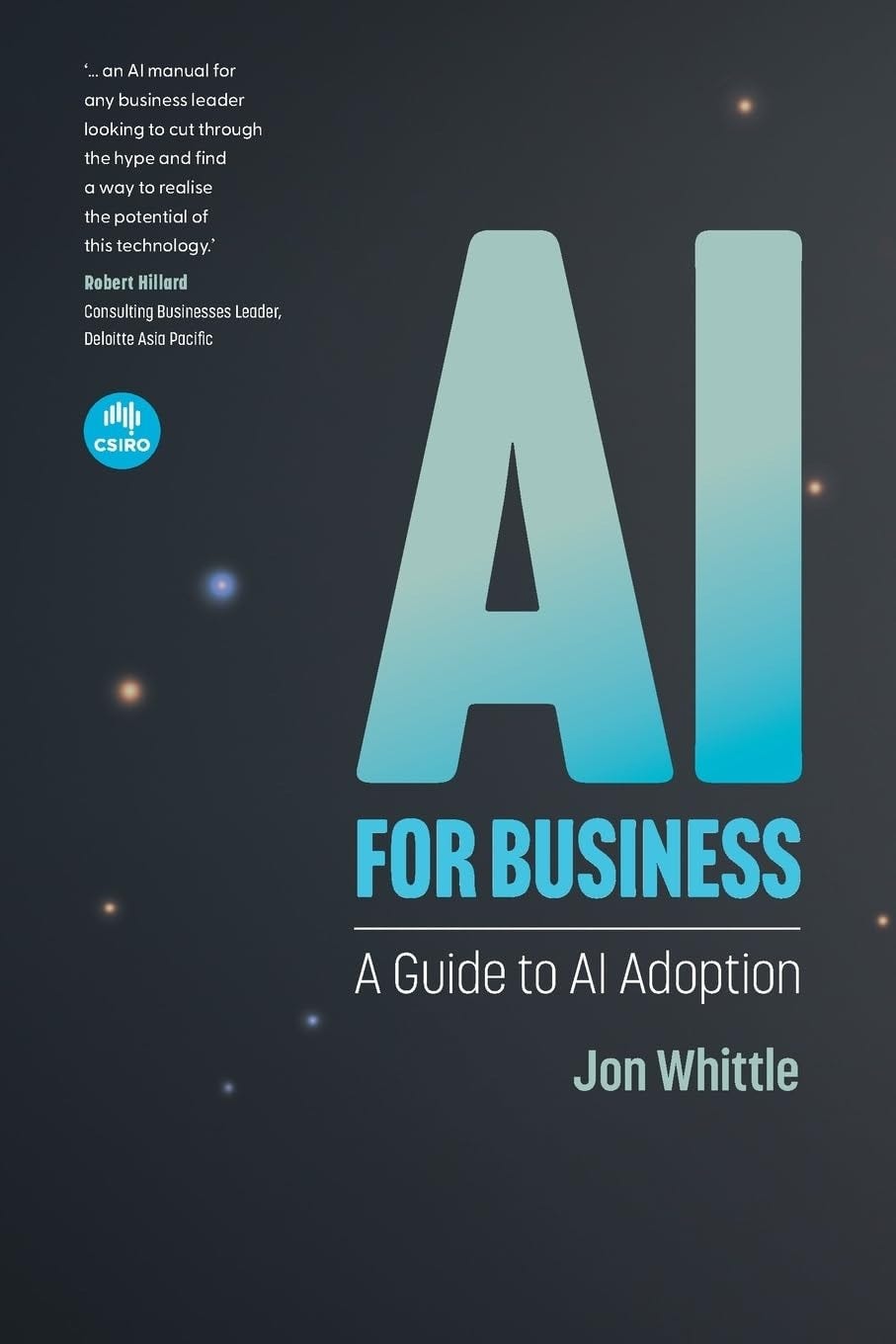
In my book, AI for Business, I identify three types of organisation. AI Disrupters use AI to fundamentally shift their business model. AI Adaptors use it to make existing operations more efficient. And AI Watchers wait for someone else to go first.
Our task, as a nation, is to move more of those watchers into adaptors and more of those adaptors into disrupters.
That will be my focus for the next few years.
As I try to do my bit for Australian AI, however small, I am reminded how I first came across the term artificial intelligence. It was 1993. I had just finished a degree in mathematics at Oxford, and I was wondering what I was going to do with my life. One afternoon, I walked into the university careers library (back when we had such things) and started flicking through material for inspiration. After two hours, I was about to give up and head to the college bar when I chanced upon an ad for a Masters in Artificial Intelligence at the University of Edinburgh. I’d never heard of AI at the time, but it sounded so fantastical that, at that moment, I think I unconsciously knew that it would define the rest of my life and career.
It was perhaps a serendipitous moment for me to find AI in this way. But then again, I’ve always believed that serendipity doesn’t just happen; you make it happen. It was me who decided to walk into that library. It was me who was open to whatever I found in there. And that’s how our nation needs to be with AI.
Be open. Lean in. And who knows — serendipity might just do the rest.
Interesting. And informative. But you call out the glaring flaw in our national AI strategy. It is built on non-sovereign black box models. It doesn’t matter where we choose to store the Trojan horse.
It is still inside our walls. Maybe the bigger flaw is Australia does not really do Strategy - it does Soundbites. Action is significantly harder than Announcements…